Why is it so difficult to talk about extreme violence? What makes the testimony of atrocity stand out among other forms of testimonies? Why is telling about theft not the same as talking about being sleep deprived by your father?
Those were some of the questions I had in mind when I studied Women Unsilenced: Our Refusal to Let Torturer-Traffickers Win (2022) by Jeanne Sarson and Linda MacDonald, in which the two Canadian nurses turned activists tell about the horrors of torture in a domestic context and how they physically and legally supported female victims.
I’ve looked into the philosophy of testimony, more specifically at the literature on the testimony of atrocity which primarily focuses on the Shoah. I’ve dwelt on Giorgio Agamben’s Remnants of Auschwitz: The Witness and the Archive (2000). In ‘Testimony, Violence and Silence: An Examination of Agamben and his Critics’, I responded to his view of the survivor of atrocity as an imperfect witness for to experience such a horrific event is to be condemned to silence (aka dead).
This is a caricature, of course, I’m just jotting down a few paragraphs on my phone, but if you want to read the fully fleshed, nuanced academic paper, you can read it on the Dignity website here. I’ll make a separate post summarising it this winter, something digestible and hopefully memorable — how ambitious of me, good thing that where I live winter extends to March.
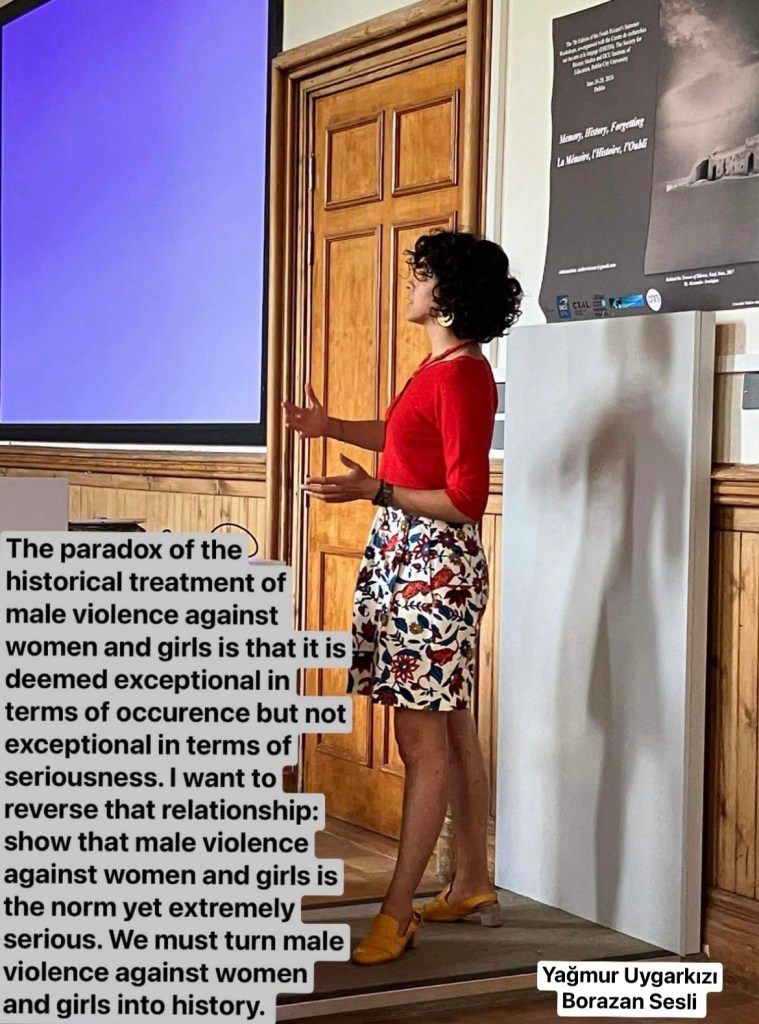
This post is about a presentation I gave last June at the Fonds Ricœur Summer Workshop at the UCD (University College Dublin). I had the same questions, the same goal – demonstrating that male violence against women and girls is a type of atrocity that brings about its unique set of challenges to the question of testimony (and to women and girls’ lives of course) – but responded to a different author, Paul Ricœur. In Memory, History, Forgetting (2004), as much as he acknowledges the conundrum for the survivor of atrocities, Paul Ricœur still reduces testimony to a simple three-step procedure as if it was some sort of Clinique beauty routine: ‘I was there’, ‘Believe me’, ‘If you don’t believe me, ask others’. Again, and obviously, his analysis is more nuanced than that and I’ll publish my written response this autumn (seems like I’m finally posting content on this website this year).

In the meantime, you can listen to my speech below. It’s in French and English, full of jargon, I promise it’ll be easier to read, and if I can’t live up to my promise, please let me know.
 Borazan Sesli